Latest SAA-C03 Test Labs, SAA-C03 Preparation Store
Wiki Article
What's more, part of that TestsDumps SAA-C03 dumps now are free: https://drive.google.com/open?id=1v22ZFWcT_uFXCezYEiymV8fhjDb3INiJ
Free demo is available for SAA-C03 training materials, so that you can have a better understanding of what you are going to buy. Free demo will represent you what the complete version is like. We suggest you try free domo before buying. In addition, SAA-C03 training materials are high quality and accuracy, since we have a professional team to collect the latest information of the exam. Therefore if you choose SAA-C03 Exam Dumps of us, you can get the latest version timely. We provide you with free update version for one year for SAA-C03 training materials.
Amazon SAA-C03 certification is a valuable asset for individuals who want to demonstrate their expertise in AWS solutions architecture. It is recognized by organizations worldwide and is a requirement for many AWS-related job roles. Being certified in AWS solutions architecture can lead to increased job opportunities and higher pay. Additionally, it can help individuals gain a competitive edge in the job market and provide them with the skills and knowledge necessary to design and implement complex AWS solutions.
The SAA-C03 Certification Exam covers a wide range of topics, including AWS architecture, deployment, security, and troubleshooting. Candidates are required to have a strong understanding of AWS services, including EC2, S3, RDS, and VPC. They should also be familiar with AWS best practices and have hands-on experience with AWS services.
>> Latest SAA-C03 Test Labs <<
100% Pass 2026 Amazon SAA-C03: AWS Certified Solutions Architect - Associate Fantastic Latest Test Labs
The APP online version of our SAA-C03 real quiz boosts no limits for the equipment being used and it supports any electronic equipment and the off-line use. So you can apply this version of our SAA-C03 exam questions on IPAD, phone and laptop just as you like. If only you open it in the environment with the network for the first time you can use our SAA-C03 Training Materials in the off-line condition later. You will find that APP online version is quite enjoyable to learn our study materials.
The SAA-C03 Certification Exam is intended for professionals who have experience with AWS services and are familiar with cloud computing concepts. SAA-C03 exam tests the candidate's understanding of AWS core services, including Amazon Elastic Compute Cloud (EC2), Amazon Simple Storage Service (S3), Amazon Elastic Block Store (EBS), Amazon Relational Database Service (RDS), Amazon Virtual Private Cloud (VPC), and AWS Identity and Access Management (IAM).
Amazon AWS Certified Solutions Architect - Associate Sample Questions (Q386-Q391):
NEW QUESTION # 386
[Design Resilient Architectures]
A company is preparing to launch a public-facing web application in the AWS Cloud. The architecture consists of Amazon EC2 instances within a VPC behind an Elastic Load Balancer (ELB). A third-party service is used for the DNS. The company's solutions architect must recommend a solution to detect and protect against large-scale DDoS attacks.
Which solution meets these requirements?
- A. Enable AWS Shield Advanced and assign the ELB to it.
- B. Enable Amazon GuardDuty on the account.
- C. Enable Amazon Inspector on the EC2 instances.
- D. Enable AWS Shield and assign Amazon Route 53 to it.
Answer: A
Explanation:
https://aws.amazon.com/shield/faqs/
NEW QUESTION # 387
A company plans to host a movie streaming app in AWS. The chief information officer (CIO) wants to ensure that the application is highly available and scalable. The application is deployed to an Auto Scaling group of EC2 instances on multiple AZs. A load balancer must be configured to distribute incoming requests evenly to all EC2 instances across multiple Availability Zones.
Which of the following features should the Solutions Architect use to satisfy these criteria?
- A. Cross-zone load balancing
- B. Amazon VPC IP Address Manager (IPAM)
- C. AWS Direct Connect SiteLink
- D. Path-based Routing
Answer: A
Explanation:
The nodes for your load balancer distribute requests from clients to registered targets. When cross-zone load balancing is enabled, each load balancer node distributes traffic across the registered targets in all enabled Availability Zones. When cross-zone load balancing is disabled, each load balancer node distributes traffic only across the registered targets in its Availability Zone.
The following diagrams demonstrate the effect of cross-zone load balancing. There are two enabled Availability Zones, with two targets in Availability Zone A and eight targets in Availability Zone
B: Clients send requests, and Amazon Route 53 responds to each request with the IP address of one of the load balancer nodes. This distributes traffic such that each load balancer node receives 50% of the traffic from the clients. Each load balancer node distributes its share of the traffic across the registered targets in its scope.
If cross-zone load balancing is enabled, each of the 10 targets receives 10% of the traffic. This is because each load balancer node can route 50% of the client traffic to all 10 targets.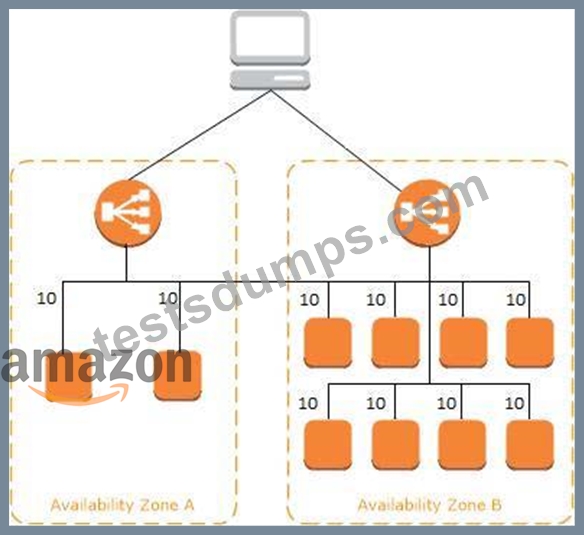
If cross-zone load balancing is disabled:
Each of the two targets in Availability Zone A receives 25% of the traffic.
Each of the eight targets in Availability Zone B receives 6.25% of the traffic.
This is because each load balancer node can route 50% of the client traffic only to targets in its Availability Zone.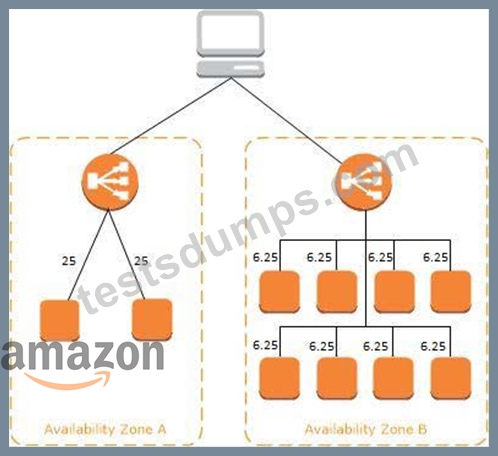
With Application Load Balancers, cross-zone load balancing is always enabled.
With Network Load Balancers and Gateway Load Balancers, cross-zone load balancing is disabled by default. After you create the load balancer, you can enable or disable cross-zone load balancing at any time.
When you create a Classic Load Balancer, the default for cross-zone load balancing depends on how you create the load balancer. With the API or CLI, cross-zone load balancing is disabled by default. With the AWS Management Console, the option to enable cross-zone load balancing is selected by default.
After you create a Classic Load Balancer, you can enable or disable cross-zone load balancing at any time Hence, the right answer is to enable cross-zone load balancing.
Amazon VPC IP Address Manager (IPAM) is incorrect because this is merely a feature in Amazon VPC that provides network administrators with an automated IP management workflow. It does not enable your load balancers to distribute incoming requests evenly to all EC2 instances across multiple Availability Zones.
Path-based Routing is incorrect because this feature is based on the paths that are in the URL of the request. It automatically routes traffic to a particular target group based on the request URL. This feature will not set each of the load balancer nodes to distribute traffic across the registered targets in all enabled Availability Zones.
AWS Direct Connect SiteLink is incorrect because this is a feature of AWS Direct Connect connection and not of Amazon Elastic Load Balancing. The AWS Direct Connect SiteLink feature simply lets you create connections between your on-premises networks through the AWS global network backbone.
References:
https://docs.aws.amazon.com/elasticloadbalancing/latest/userguide/how-elastic-load-balancing-works.html
https://aws.amazon.com/elasticloadbalancing/features
https://aws.amazon.com/blogs/aws/network-address-management-and-auditing-at-scale-with-amazon-vpc-ip-address-manager/
AWS Elastic Load Balancing Overview:
https://youtu.be/UBl5dw59DO8
Check out this AWS Elastic Load Balancing (ELB) Cheat Sheet:
https://tutorialsdojo.com/aws-elastic-load-balancing-elb/
NEW QUESTION # 388
A solutions architect is provisioning an Amazon Elastic File System (Amazon EFS) file system to provide shared storage across multiple Amazon EC2 instances. The instances all exist in the same VPC across multiple Availability Zones. There are two instances in each Availability Zone. The solutions architect must make the file system accessible to each instance with the lowest possible latency.
Which solution will meet these requirements?
- A. Create a mount target for each instance. Use each mount target to mount the EFS file system on each respective instance.
- B. Create a mount target in each Availability Zone of the VPC. Use the mount target to mount the EFS file system on the instances in the respective Availability Zone.
- C. Create a mount target for the EFS file system in the VPC. Use the mount target to mount the file system on each of the instances.
- D. Create a mount target for the EFS file system in one Availability Zone of the VPC. Use the mount target to mount the file system on the instances in that Availability Zone. Share the directory with the other instances.
Answer: B
Explanation:
Amazon EFS requires a mount target in each Availability Zone where EC2 instances access the file system. This is because each mount target provides an elastic network interface in the subnet and AZ, reducing network latency by allowing EC2 instances to communicate locally with the EFS mount target. Creating a mount target in each AZ optimizes file system access performance and availability. Instances mount the EFS file system via the mount target in their respective AZ, which provides the lowest possible latency and avoids cross-AZ traffic.
Option A, with only a single mount target in the VPC, will cause cross-AZ traffic for instances in other AZs, increasing latency and potentially incurring data transfer costs. Option B is incomplete and introduces complexity with sharing directories across instances. Option C is invalid because mount targets are per AZ and per subnet, not per instance.
Reference:
Amazon EFS Overview (https://docs.aws.amazon.com/efs/latest/ug/whatisefs.html) Creating Mount Targets (https://docs.aws.amazon.com/efs/latest/ug/manage-fs-access.html#creating-mount-targets) AWS Well-Architected Framework - Performance Efficiency Pillar (https://d1.awsstatic.com/whitepapers/architecture/AWS_Well-Architected_Framework.pdf)
NEW QUESTION # 389
A company needs to deploy at least 2 EC2 instances to support the normal workloads of its application and automatically scale up to 6 EC2 instances to handle the peak load. The architecture must be highly available and fault-tolerant as it is processing mission-critical workloads.
As the Solutions Architect of the company, what should you do to meet the above requirement?
- A. Create an Auto Scaling group of EC2 instances and set the minimum capacity to 4 and the maximum capacity to 6. Deploy 2 instances in Availability Zone A and another 2 instances in Availability Zone B.
- B. Create an Auto Scaling group of EC2 instances and set the minimum capacity to 2 and the maximum capacity to 6. Use 2 Availability Zones and deploy 1 instance for each AZ.
- C. Create an Auto Scaling group of EC2 instances and set the minimum capacity to 2 and the maximum capacity to 4. Deploy 2 instances in Availability Zone A and 2 instances in Availability Zone B.
- D. Create an Auto Scaling group of EC2 instances and set the minimum capacity to 2 and the maximum capacity to 6. Deploy 4 instances in Availability Zone A.
Answer: A
Explanation:
Amazon EC2 Auto Scaling helps ensure that you have the correct number of Amazon EC2 instances available to handle the load for your application. You create collections of EC2 instances, called Auto Scaling groups. You can specify the minimum number of instances in each Auto Scaling group, and Amazon EC2 Auto Scaling ensures that your group never goes below this size. You can also specify the maximum number of instances in each Auto Scaling group, and Amazon EC2 Auto Scaling ensures that your group never goes above this size.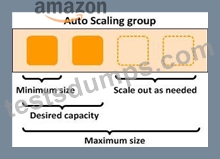
To achieve highly available and fault-tolerant architecture for your applications, you must deploy all your instances in different Availability Zones. This will help you isolate your resources if an outage occurs.
Take note that to achieve fault tolerance, you need to have redundant resources in place to avoid any system degradation in the event of a server fault or an Availability Zone outage. Having a fault-tolerant architecture entails an extra cost in running additional resources than what is usually needed. This is to ensure that the mission-critical workloads are processed.
Since the scenario requires at least 2 instances to handle regular traffic, you should have 2 instances running all the time even if an AZ outage occurred. You can use an Auto Scaling Group to automatically scale your compute resources across two or more Availability Zones. You have to specify the minimum capacity to 4 instances and the maximum capacity to 6 instances. If each AZ has 2 instances running, even if an AZ fails, your system will still run a minimum of 2 instances.
Hence, the correct answer in this scenario is: Create an Auto Scaling group of EC2 instances and set the minimum capacity to 4 and the maximum capacity to 6. Deploy 2 instances in Availability Zone A and another 2 instances in Availability Zone B.
The option that says: Create an Auto Scaling group of EC2 instances and set the minimum capacity to 2 and the maximum capacity to 6. Deploy 4 instances in Availability Zone A is incorrect because the instances are only deployed in a single Availability Zone. It cannot protect your applications and data from datacenter or AZ failures.
The option that says: Create an Auto Scaling group of EC2 instances and set the minimum capacity to 2 and the maximum capacity to 6. Use 2 Availability Zones and deploy 1 instance for each AZ is incorrect.
It is required to have 2 instances running all the time. If an AZ outage happened, ASG will launch a new instance on the unaffected AZ. This provisioning does not happen instantly, which means that for a certain period of time, there will only be 1 running instance left.
The option that says: Create an Auto Scaling group of EC2 instances and set the minimum capacity to 2 and the maximum capacity to 4. Deploy 2 instances in Availability Zone A and 2 instances in Availability Zone B is incorrect. Although this fulfills the requirement of at least 2 EC2 instances and high availability, the maximum capacity setting is wrong. It should be set to 6 to properly handle the peak load. If an AZ outage occurs and the system is at its peak load, the number of running instances in this setup will only be 4 instead of 6 and this will affect the performance of your application. References:
https://docs.aws.amazon.com/autoscaling/ec2/userguide/what-is-amazon-ec2-auto-scaling.html
https://docs.aws.amazon.com/documentdb/latest/developerguide/regions-and-azs.html Check out this AWS Auto Scaling Cheat Sheet:
https://tutorialsdojo.com/aws-auto-scaling/
NEW QUESTION # 390
A company runs containers in a Kubernetes environment in the company's local data center. The company wants to use Amazon Elastic Kubernetes Service (Amazon EKS) and other AWS managed services Data must remain locally in the company's data center and cannot be stored in any remote site or cloud to maintain compliance Which solution will meet these requirements?
- A. Install an AWS Outposts rack in the company's data center
- B. Deploy AWS Local Zones in the company's data center
- C. Install an AWS Snowball Edge Storage Optimized node in the data center
- D. Use an AWS Snowmobile in the company's data center
Answer: A
Explanation:
AWS Outposts is a fully managed service that delivers AWS infrastructure and services to virtually any on-premises or edge location for a consistent hybrid experience. AWS Outposts supports Amazon EKS, which is a managed service that makes it easy to run Kubernetes on AWS and on-premises. By installing an AWS Outposts rack in the company's data center, the company can run containers in a Kubernetes environment using Amazon EKS and other AWS managed services, while keeping the data locally in the company's data center and meeting the compliance requirements. AWS Outposts also provides a seamless connection to the local AWS Region for access to a broad range of AWS services.
Option A is not a valid solution because AWS Local Zones are not deployed in the company's data center, but in large metropolitan areas closer to end users. AWS Local Zones are owned, managed, and operated by AWS, and they provide low-latency access to the public internet and the local AWS Region. Option B is not a valid solution because AWS Snowmobile is a service that transports exabytes of data to AWS using a 45-foot long ruggedized shipping container pulled by a semi-trailer truck. AWS Snowmobile is not designed for running containers or AWS managed services on-premises, but for large-scale data migration. Option D is not a valid solution because AWS Snowball Edge Storage Optimized is a device that provides 80 TB of HDD or 210 TB of NVMe storage capacity for data transfer and edge computing. AWS Snowball Edge Storage Optimized does not support Amazon EKS or other AWS managed services, and it is not suitable for running containers in a Kubernetes environment.
References:
* AWS Outposts - Amazon Web Services
* Amazon EKS on AWS Outposts - Amazon EKS
* AWS Local Zones - Amazon Web Services
* AWS Snowmobile - Amazon Web Services
* [AWS Snowball Edge Storage Optimized - Amazon Web Services]
NEW QUESTION # 391
......
SAA-C03 Preparation Store: https://www.testsdumps.com/SAA-C03_real-exam-dumps.html
- SAA-C03 Study Materials - SAA-C03 Certification Training - SAA-C03 Best Questions ???? Download 「 SAA-C03 」 for free by simply searching on ⇛ www.testkingpass.com ⇚ ????New SAA-C03 Practice Questions
- SAA-C03 Test Braindumps: AWS Certified Solutions Architect - Associate - SAA-C03 Quiz Materials - SAA-C03 Exam Torrent ???? Search for ▛ SAA-C03 ▟ and download it for free immediately on 【 www.pdfvce.com 】 ????SAA-C03 Exam Topic
- Achieve Your Goals with Real Amazon SAA-C03 Exam Questions ???? Easily obtain ( SAA-C03 ) for free download through ➽ www.prepawaypdf.com ???? ????Reliable SAA-C03 Braindumps Book
- SAA-C03 Guide ???? SAA-C03 Reliable Dumps Questions ???? Valid SAA-C03 Test Forum ???? Enter ☀ www.pdfvce.com ️☀️ and search for ▶ SAA-C03 ◀ to download for free ????SAA-C03 Actual Braindumps
- Best SAA-C03 Vce ???? New SAA-C03 Practice Questions ???? Valid SAA-C03 Test Forum ???? Copy URL ☀ www.easy4engine.com ️☀️ open and search for { SAA-C03 } to download for free ????Instant SAA-C03 Discount
- SAA-C03 Study Materials - SAA-C03 Certification Training - SAA-C03 Best Questions ???? Search for “ SAA-C03 ” and download it for free on ➠ www.pdfvce.com ???? website ????Latest SAA-C03 Guide Files
- Test SAA-C03 Testking ▶ SAA-C03 Test Questions Vce ???? SAA-C03 Valid Dumps Free ???? Simply search for ⇛ SAA-C03 ⇚ for free download on ➽ www.prepawayete.com ???? ????Latest SAA-C03 Demo
- 100% Free SAA-C03 – 100% Free Latest Test Labs | Professional AWS Certified Solutions Architect - Associate Preparation Store ???? Easily obtain ▷ SAA-C03 ◁ for free download through { www.pdfvce.com } ????Latest SAA-C03 Guide Files
- Instant SAA-C03 Discount ???? Latest SAA-C03 Guide Files ???? Certification SAA-C03 Test Questions ???? Copy URL ➥ www.vce4dumps.com ???? open and search for 《 SAA-C03 》 to download for free ????Test SAA-C03 King
- 100% Free SAA-C03 – 100% Free Latest Test Labs | Professional AWS Certified Solutions Architect - Associate Preparation Store ???? Search for “ SAA-C03 ” and download it for free immediately on ⏩ www.pdfvce.com ⏪ ????Study SAA-C03 Reference
- Reliable SAA-C03 Braindumps Book ???? Instant SAA-C03 Discount ???? Study SAA-C03 Reference ???? Enter ✔ www.prepawaypdf.com ️✔️ and search for ▛ SAA-C03 ▟ to download for free ????Valid SAA-C03 Test Forum
- anyaxpot622064.wikikarts.com, bookmarkgenious.com, directoryhand.com, livebookmarking.com, jadaavpp269144.empirewiki.com, gregorylosh044521.blogsumer.com, nettiefphy271479.blgwiki.com, mnobookmarks.com, abelpusf308714.evawiki.com, bookmarkalexa.com, Disposable vapes
2026 Latest TestsDumps SAA-C03 PDF Dumps and SAA-C03 Exam Engine Free Share: https://drive.google.com/open?id=1v22ZFWcT_uFXCezYEiymV8fhjDb3INiJ
Report this wiki page